Marble Madness is a four-minute game. Six courses, a timer counting down, and a marble that does exactly what physics would suggest when you roll it off a ledge. Most arcade players never saw the final level. Many never made it past the third. The game was the highest-earning title in the arcades Atari tracked — and then, consistently, it fell off the chart in week seven. Every single time.
Mark Cerny, who designed it, understood why. “It’s a four-minute game,” he said years later. He wished he’d made it eight. The economics of arcade development in 1984 — Atari was haemorrhaging money, the factory needed to stay busy, there was no time — meant the game shipped with what it had. Six courses. Four minutes for anyone good enough. And then it was over.
It didn’t matter. Marble Madness was extraordinary.
A 17-Year-Old and M.C. Escher
Mark Cerny joined Atari at 17. He was already known in gaming circles as an exceptional player — Atari ran a design competition for outsiders, Cerny won it, and they hired him. His first shipped game was Marble Madness, released in December 1984. He was still a teenager.
The design process went through several iterations. Cerny’s first idea was miniature golf — he was captivated by the way a playing surface’s contours determined a ball’s path. Atari weren’t interested. He moved to racing games, planning long tracks with opponents, but the physics required were beyond what the hardware could handle. He settled on something simpler and stranger: a race against time, on courses that had no real-world logic, inspired by the impossible geometries of M.C. Escher.
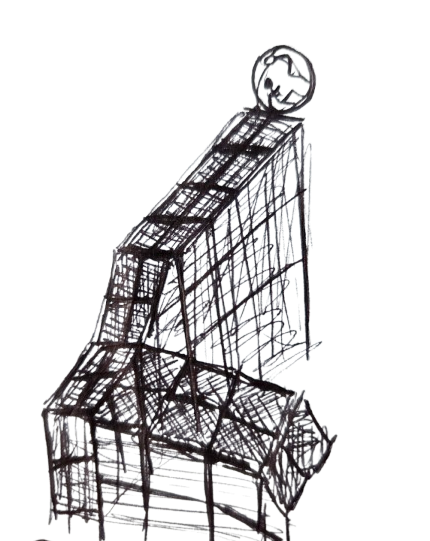
Escher’s influence is visible in every screen. The isometric perspective, the impossible angles, the sense that the world doesn’t quite obey the rules you expect — it’s unmistakably there. Cerny wanted a game where nothing had eyes, where the aesthetic was abstract and architectural rather than cute or cartoonish. Late in development, Atari pushed for a smiley face on the marble, to give it a mascot-like identity. Cerny resisted. They compromised: a subtle hint of a smile on the cabinet artwork, nothing on the marble itself. The marble remained a marble. Pure and abstract, rolling through impossible worlds.
The Trackball
You controlled the marble with a trackball — a large, motorised sphere that spun freely and responded to the speed and direction of your hand. The motorisation was deliberate: the trackball would spin faster when the marble moved downhill, slower going up. It gave physical feedback that no joystick or d-pad could replicate. You weren’t just controlling the marble — you could feel the gradient.
This is also why almost every home conversion felt like something was missing. The trackball was not just a control method — it was part of the experience. Playing Marble Madness with a joystick or a d-pad is like listening to a great piece of music through a wall. You can hear the shape of it, but the texture is gone.
The trackball also had a famous practical problem: it broke constantly. The mechanism wasn’t built for the volume of use a popular arcade machine attracted, and operators spent a lot of time maintaining them. A broken trackball was the most common reason Marble Madness went out of service.
The Sound
Marble Madness was the first arcade game to use an FM sound chip — a Yamaha synthesiser similar to the DX7 that was redefining studio music at the same time. Composers Brad Fuller and Hal Canon spent months learning what the chip could do, and the result was the first arcade game with true stereo sound. The music didn’t just play over the game — it was synchronised to the action in real time.
The soundtrack is genuinely strange and genuinely brilliant. Urgent, percussive, slightly anxious — it captures the feeling of rolling a marble toward a precipice and knowing you’re about to make a mistake. The Beginner Race theme in particular has lodged itself in the memory of anyone who played the game in the mid-1980s and has never quite come out again.
And then there’s the death sound. If you played Marble Madness in the arcade, you know exactly what this means. That descending, mocking “wah wah wah” that plays every time your marble falls off the edge — perfectly timed, perfectly pitched to twist the knife. It’s one of gaming’s most effective pieces of audio cruelty. Short enough that you hear the whole thing before your replacement marble drops in. Long enough to make sure you’ve fully registered what just happened. Nobody who spent time with this game in the mid-1980s has ever fully forgotten it. There is a reasonable argument that it belongs alongside Barney the Dinosaur’s theme song in the annals of audio designed, consciously or otherwise, to break the human spirit.
The NES conversion had its soundtrack arranged by David Wise of Rare — entirely by ear, working from the original without any reference materials beyond what he could hear. It’s a testament to Wise’s ability that the NES version sounds as good as it does given the hardware constraints.
The Courses
Six courses: Practice Race, Beginner Race, Intermediate Race, Aerial Race, Silly Race, and Ultimate Race. The names tell you something. Practice is forgiving enough that you can learn the basics. Beginner is where the game starts being unkind. Intermediate is where most players began to feel genuinely out of their depth. Aerial has you navigating a course with enormous drops and little margin for error. Silly introduces enemies and obstacles that seem designed specifically to humiliate you. Ultimate is, if you somehow reach it, the game’s final statement — everything it’s been building to, compressed into one last run.
The enemies are memorable in part because of Cerny’s minimalist design philosophy. The Marble Muncher rolls toward you and eats time off your clock. The Steelies — other marbles — career across the course trying to knock you off. The Vacs hover and attempt to suck your marble into oblivion. None of them have faces. None of them need them.
The Conversions
Marble Madness was ported to almost everything. The Amiga version, released in 1986, was widely regarded as the best home conversion — close enough to arcade-quality in its graphics that one reviewer at the time called it superior to the original. The Mega Drive version is also well-regarded. The NES version, handled by Rare, is playable and has that David Wise soundtrack. The Game Boy version holds up surprisingly well for what it is.
The worst conversions — ZX Spectrum, DOS, Game Boy Advance — suffered from the same problems: poor graphics, worse collision detection, and no trackball. The Spectrum version in particular is a dispiriting experience for anyone who remembers the arcade original.
A sequel — Marble Man: Marble Madness II — was developed in 1991 without Cerny’s involvement. Location testing revealed it couldn’t compete with the titles around it, and it was cancelled before release. The original remained the definitive statement.
The Legacy
Mark Cerny went on to become one of the most significant figures in gaming hardware — he was the lead architect of the PlayStation 4, PlayStation 5, and PlayStation 5 Pro. The 17-year-old who made a marble roll through Escher-esque courses designed the consoles that a significant portion of the gaming world plays on today.
Marble Madness itself spawned a genre — or at least demonstrated that a genre was possible. The isometric ball-rolling game it invented has descendants across decades: Super Monkey Ball, Ballance, and countless others all owe something to the logic Cerny established in 1984. Guide a ball through a course using physics as both tool and obstacle. Add a timer. Make it harder. It sounds simple. It turns out to be enormously satisfying and almost infinitely scalable in difficulty.
Four minutes at its very best. Six courses. A trackball that felt like an extension of your hands. A soundtrack that still surfaces in the memory, unprompted, decades later. It’s enough.
Where to Play It Now
The arcade original is available via MAME emulation — the most accurate way to experience the game as it was, though you’ll need a decent trackball peripheral to get close to the original feel. USB trackballs are available and make a significant difference.
The Mega Drive version is available physically and is the best console alternative. The Amiga version is accessible through Amiga emulation and is worth seeking out. The NES version runs on virtually any NES emulator and has that Wise soundtrack going for it.
It has not, as of 2026, received a modern re-release or remaster. Given how well its abstract aesthetic has aged — better than almost anything else from 1984 — this remains a missed opportunity.
Looking Back is a monthly series revisiting games that mattered. Next month: Streets of Rage (1991). Previous: Cannon Fodder (1993). For more on classic gaming hardware and where to play retro games today, see our Best Retro Consoles 2026 guide.