
Looking Back: Sega’s Golden Axe (1989)
By 1989, beat-’em-ups had a template, and everyone knew what it was. Two years earlier, Double Dragon had set the rules: city streets, gangs, fists. Sega’s Makoto Uchida was handed the job of making Sega’s answer to it — and decided, quietly, to ignore almost every part of the brief he’d been given. His own framing of the assignment says everything about how he approached it: he wanted to make a Double Dragon that wasn’t a Double Dragon.
Swords Instead of Fists
What he built instead was Golden Axe — a Conan-the-Barbarian fantasy world with three playable heroes, none of them remotely interested in punching anyone. Ax Battler swings a sword. Tyris Flare wields a bigger one. Gilius Thunderhead, a dwarf on a mission of revenge against the tyrant Death Adder, brings an axe roughly the size of his own torso. None of them have fists worth mentioning, because none of them need them.
The setting alone was a genuine swerve for the genre. Beat-’em-ups in 1989 were almost uniformly urban and contemporary — alleyways, warehouses, chain-link fences. Golden Axe gave players castle ramparts, forest clearings, and giant lizards to ride into battle. It looked like nothing else on the arcade floor, and that was entirely the point.
The Magic System Was the Real Innovation
The sword-swinging is satisfying enough on its own, but the mechanic that actually made Golden Axe matter was its magic system. Defeated enemies occasionally drop small blue-robed gnomes; catch one before it escapes and it fills your magic meter. Cash that meter in and you unleash a screen-clearing spell — each character has their own, from Ax Battler’s earthquake to Tyris Flare’s dragon — powerful enough to wipe out everything on screen, including bosses.
That’s a genuinely different kind of decision-making to anything Double Dragon or its imitators offered. Magic is a limited, shared resource that has to be managed rather than spammed, which turns Golden Axe into something closer to a resource-management puzzle wrapped around a brawler. Do you burn a full magic bar now to clear a dangerous crowd, or hold it for the boss you know is coming? That tension is doing more design work than the combat itself.
Then There Are the Beasts
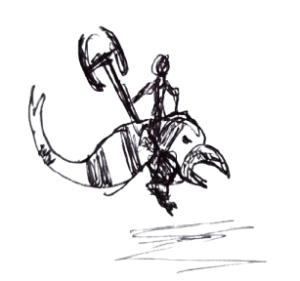
The other thing nobody else was doing: letting you steal your enemies’ rides. Knock a rider off one of Golden Axe’s giant creatures — the Bizzarko lizard, or one of the larger mounts later in the game — and you can climb on and use it yourself, complete with its own attack. It’s a small mechanical flourish, but it’s the kind of thing that makes a beat-’em-up feel alive rather than just a corridor of enemies to work through.
Why It Still Matters
Golden Axe proved something the genre needed proving in 1989: that the Double Dragon formula wasn’t a fixed set of rules, it was a starting point. Tone, setting, resource systems, mounts — all of it turned out to be negotiable, and Sega’s willingness to negotiate all of it at once is why Golden Axe still gets talked about today, while most of its contemporaries don’t.
That conversation is about to get considerably louder. An animated Golden Axe series lands on Paramount+ on 16 September — magic, dragons, and comedy, thirty-seven years after Uchida’s original cabinet. Whatever the show turns out to be, it’s proof the design still has legs decades on. Worth revisiting the original before it airs; the Force pod got its due in August, and this month it’s the earthquake spell’s turn.