Every arcade game of 1985 seemed to be about saving the world. Paperboy was about getting the Daily Sun onto the right doorsteps before breakfast. That it became one of the most loved games of the decade says a lot about how good the idea was — and about the strange, chaotic suburb Atari Games built around it.
A Kid, a Bike and an Overhead Projector
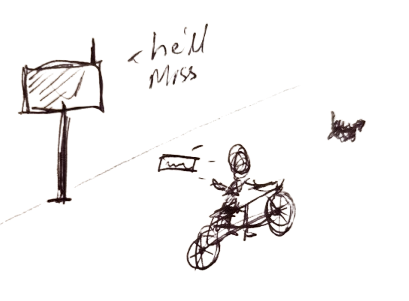
The idea came from Atari designer Dave Ralston, who pitched it at an internal brainstorming session in 1983 on a single overhead projector transparency: a kid riding down a street, delivering papers. Programmer John Salwitz, who would lead the project alongside Ralston, has admitted he wasn’t keen at first — he wanted to make something more like Missile Command or Asteroids.
The first prototypes were stranger than the finished game: rolling pianos, boats, giant snails, ducks in business suits. Focus groups didn’t take to it. As Salwitz later put it, “the reality we created was unreal.” So the team pulled it back to an ordinary American street, laid it out on foam storyboards, and kept only the best of the weirdness — the Grim Reaper among it.
Paperboy arrived in arcades in early 1985 on Atari’s new System 2 hardware, which ran at a sharper resolution than most cabinets of the day.
Handlebars, Not a Joystick
The thing everyone remembers is the controller. Instead of a joystick, the cabinet had a pair of bicycle handlebars — a modified version of the yoke from Atari’s Star Wars machine. Push forward to speed up, pull back to brake, press the buttons on either side to throw. Salwitz recalls the handlebars getting narrower during development because players were putting so much force through them, and the start buttons moving onto the controller after shorter players couldn’t reach them.
It’s a perfect example of what arcade games could do that home machines couldn’t: the control itself told you what the game was about before you’d put a coin in.
Monday to Sunday, If You Last That Long
The structure was simple and brilliant. Each level is a day of the week, Monday to Sunday, on one of three streets — Easy Street, Middle Road or the Hard Way. Some houses subscribe to the Daily Sun; deliver to their porch or mailbox and they stay happy. Miss one, or put a paper through their window, and they cancel. The houses that don’t subscribe are fair game, and smashing their windows earns points.
That small choice — dutiful paperboy or suburban vandal — gave the game its personality. Salwitz has said the paperboy was never meant to be a hooligan, but plenty of players treated him like one. Meanwhile the street fights back with cars, skateboarders, rolling tyres and worse. Each day ends with a training course of ramps and targets, and the heavier Sunday papers make the last day the hardest of the week.
Number One on the Spectrum
For British players, Paperboy is as much a home computer game as an arcade one. Elite Systems brought it to the ZX Spectrum in September 1986, and it went straight to number one in the UK charts. The Commodore 64 version took it back to the top in November, and it finished as one of the best-selling games of the year in the UK, with versions following on the Amstrad CPC, BBC Micro and more.
Those ports had an obvious problem — no handlebars — and reviews of the home versions often criticised the controls. In the US, Mindscape’s NES version was famously rough around the edges, yet Salwitz has said it sold more than two million copies. Paperboy went on to appear on practically everything: the Master System, Mega Drive, Game Boy, Atari Lynx and more, followed by a sequel, Paperboy 2, in 1991 and a 3D reimagining on the Nintendo 64 in 1999.
Why It Still Matters
Paperboy proved that an arcade game didn’t need spaceships or martial artists to be thrilling. Its isometric street, its moral mischief and its daily routine gave it a rhythm few games of its era had — and it remains one of the best-remembered games from Atari Games’ extraordinary run in the mid-1980s.
Playing it now takes a little effort. The original arcade game appears in the Midway Arcade Treasures compilation on PS2, Xbox and GameCube, and on a Midway-themed Arcade1Up home cabinet, while original cartridges and tapes for the home versions are easy to find second-hand. There’s no simple modern digital re-release — partly because of the tangled history of who owns Atari Games’ library, which we unpick in this month’s companion piece, Looking Back: Atari Games. For another game from the same company, see our Marble Madness retrospective.
Looking Back is a monthly series revisiting games that mattered. Previous: Metal Slug (1996). Next: Star Fox.